Key takeaways
- Confirm your category is eligible under OpenAI’s current ad policies before planning anything else.
- Install conversion tracking first; an ad you cannot measure is an ad you cannot improve.
- The landing page and lead follow-up decide results more often than the ad itself.
- Judge the test on qualified leads and revenue, not clicks.
Why readiness matters more than speed
ChatGPT advertising is new, and new channels reward the businesses that are prepared, not just the ones that arrive first. As of October 2026, OpenAI reports that ChatGPT ads are available in dozens of countries through a self-serve Ads Manager, with no minimum spend. Getting started is easy. Getting a return is the hard part.
The checklist below is the same order of operations we follow before launching any paid test. Each item is cheap to fix before launch and expensive to discover afterward.
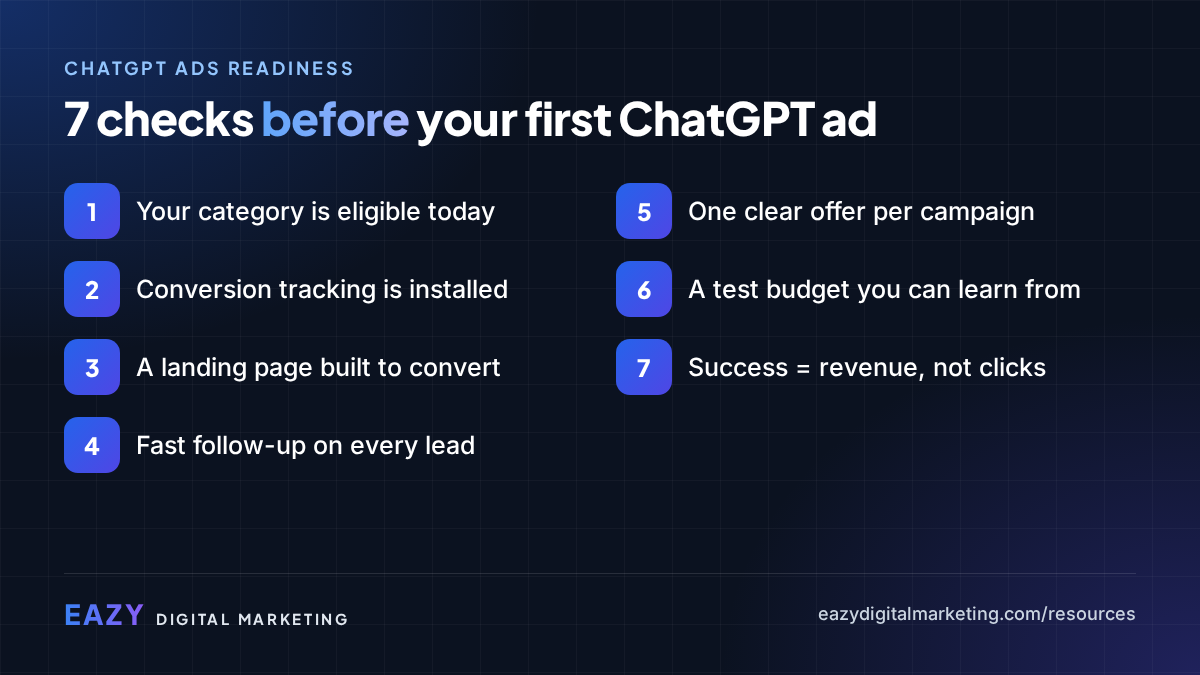
1. Your category is eligible today
Per OpenAI, ads appear only for adult users on certain plans, are labeled “Sponsored,” are kept separate from answers, and are not shown next to sensitive topics such as health, mental health or politics. Some advertiser categories are restricted.
For healthcare, dental and other regulated businesses, this is the first question to settle — not the last. Read the current official policy for your category before you write a single headline. Policies change, so re-check them before every new campaign.
2. Conversion tracking is installed and tested
OpenAI offers a pixel and a Conversions API for measuring results. Whatever tools you use, the rule is the same: before launch, submit a real test lead and confirm it was recorded. Calls, form fills and bookings should all be counted, and you should be able to tell which ones came from the ad.
3. A landing page built to convert
Sending paid traffic to a general homepage is the most common and most costly mistake. Someone arriving from a conversation has already explained what they want. The page should match that intent with one offer, clear proof, honest pricing context and a fast way to act.
- One page per offer, with a headline that matches the ad.
- Tap-to-call and online booking visible without scrolling on mobile.
- A short form; ask only what you need for the first conversation.
4. Fast follow-up on every lead
Paid leads cool quickly. Decide before launch who answers the phone, who replies to forms, and how fast. If leads arrive after hours, have a plan for them. A strong ad with slow follow-up wastes budget just as surely as a weak ad.
5. One clear offer per campaign
ChatGPT ads use a compact format: a headline, a short description, an image and a link. There is no room for a list of everything you do. Pick the single service with the clearest demand and the strongest margin, and build the campaign around it.
6. A test budget you can learn from
Set a budget you are comfortable treating as a learning investment, and a fixed test window to go with it. Agree in advance on what result would justify scaling, what would justify changing the offer or page, and what would justify stopping.
7. Success defined as revenue, not clicks
Clicks and impressions show that an ad is running. They do not show that it is working. Track the path from click to lead to booked appointment to paying customer, and judge the test on the far end of that path.
Keep paid results separate from organic AI visibility, too. A sponsored placement in ChatGPT does not change what ChatGPT says about your business in its answers. Mixing the two hides what is really producing customers.
What no one can promise
No one can guarantee ad approval for every category, a specific cost per lead, or a return on ad spend. What a good partner can promise is a disciplined test, accurate tracking and honest reporting — including when the answer is “this channel is not right for you yet.”
Share these takeaways
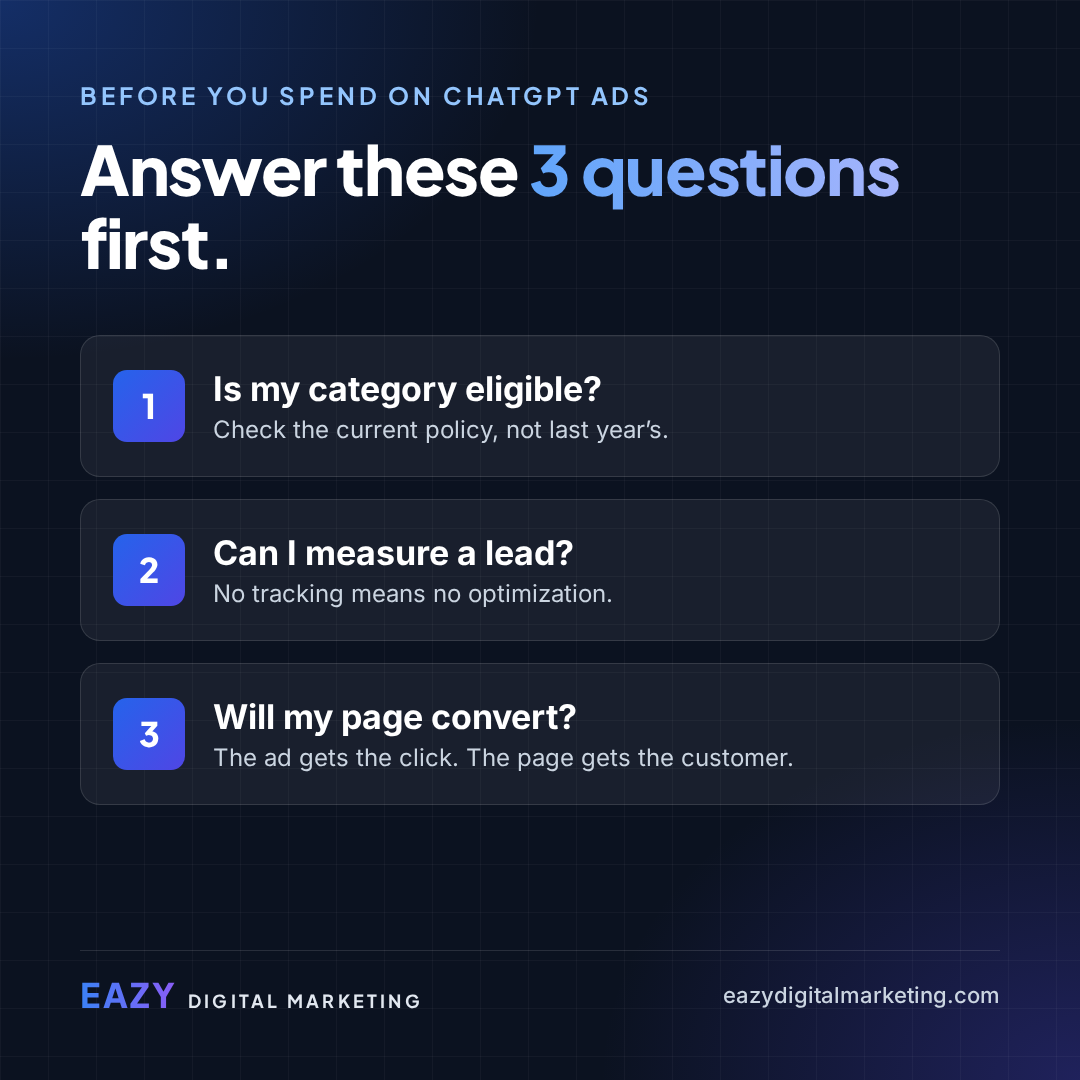
- “Before your first ChatGPT ad, answer three questions: Are we eligible? Can we measure a lead? Will the page convert?”
- “A ChatGPT ad can buy attention. Only your landing page and follow-up turn it into revenue.”
- “Clicks are a step. Revenue is the goal.”
Related services
More guides
- ChatGPT Ads vs. Google Ads: How They Differ and How They Work Together
- GEO, AEO and LLM Visibility, Explained in Plain English
- An AI Visibility Checklist for Local and Multi-Location Businesses
- Paid vs. Organic AI Visibility: Why You Must Measure Them Separately
- Google Business Profile Suspended? What to Do First (and What to Avoid)